Agile, in the dictionary:
"Agile means the ability to move quickly, easily, and adapt to change with speed and clarity."
We are now bring that to a Staking plan.
What AGILE stands for:
|
Adaptive— stake size is driven by your real edge (Kelly criterion), not a flat amount.
Guarded — stake is automatically throttled back the closer your current losing run gets to your worst-ever losing streak.
Intelligent — a bet is only recommended when the odds on offer actually beat your implied win probability (positive expected value); otherwise it says NO BET.
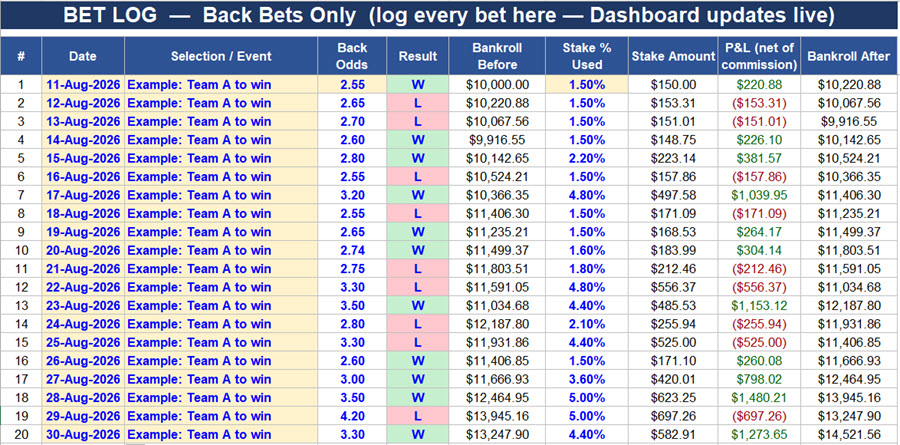
Live — every number recalculates the instant you log a new result on the Bet Log tab.
Evolving — your bankroll, strike rate and streak history all update bet-by-bet, so the plan keeps re-basing itself on your latest form.
|
Biggest Question.
Is it for you?
If you are back betting, then this is for you, as long as you are betting only one selection a race or event.
And not betting the next race or event before the result is known, so yes the result will affect how much is staked in the next race/event.
Also you would be best it you have your odds range in a band, like 2.00 to 3.50 for example on say football head to head. Or with horses 3.20 to 6.00 as an example.
Of course you can run multiple sequences on different spreadsheet or cloud session.
Assumptions & limits (read before relying on this)
|
• This models BACK bets only, at decimal odds ≥ 1.01.
• Betfair Commission (Dashboard, Settings) is charged only on the profit from a winning bet, exactly as Betfair's Exchange charges it — never on a losing bet, and never on your stake itself.
It reduces both the Bet Log's actual P&L and the advisor's recommended stake (since your real payout on a win is lower than the raw odds suggest). It's a single flat rate here as a simplification — Betfair's real commission is calculated per market on net winnings across all bets in that market, which can differ slightly from a strict bet-by-bet deduction.
• Kelly staking assumes your Strike Rate is a fair estimate of true future win probability — garbage in, garbage out. With under ~30-50 logged bets, treat recommendations as indicative, not precise.
• The model does not know about correlated bets (e.g. multiple bets on the same match or same day) — use judgement alongside it.
• Nothing here guarantees profit. Betting carries risk of loss; stake only what you can afford to lose and review the Settings periodically as your results evolve.
• All Bet Log rows beyond your data are pre-built with formulas so the sheet 'just works' as you keep adding bets — do not type over columns A, F, H, I, J (formulas) or K (hidden helper).
• Stake % Used (Bet Log) is typed the way you'd say it out loud — 0.5 for half a percent, 5 for five percent — not as a plain Excel percentage where 0.5 would mean 50%.
|
What makes AGILE different.
Most staking plans size every bet the same way regardless of the bettor's own form — a flat % or fixed unit, or a progression like Martingale/Fibonacci that increases stake after a loss and can spiral a bankroll to zero in a single bad run. AGILE takes a different approach:
• It sizes stakes off your own real, updating edge (Kelly criterion) rather than a guess or an industry-average strike rate.
• It cuts stake automatically the deeper you run into a losing streak relative to your own worst-ever run, then recovers it automatically once the run eases — the opposite of Martingale, and built to preserve capital rather than chase losses.
• It refuses to recommend a bet at all when the odds on offer don't beat your implied win probability — most staking plans only size a bet, this one first decides whether the bet is worth making.
• It recalculates itself bet-by-bet from your own logged history, so it keeps re-basing on your current form instead of a set-and-forget assumption from months ago.
|
|
|